 BirdPedy
Zaragoza y Teruel · octubre a marzoZaragoza and Teruel · October to March
Grullas en Gallocanta: cuándo ir y dónde verlasCranes at Gallocanta: when to go and where to watch
Hecha con 21 temporadas de censos oficiales, de 2005-2006 a 2025-2026, y con los estudios científicos que llevan décadas siguiendo a estas aves en la laguna.Built from 21 seasons of official counts, from 2005-2006 to 2025-2026, and from the scientific studies that have followed these birds at the lagoon for decades.
Revisado el 24 de octubre de 2026Reviewed on 24 October 2026
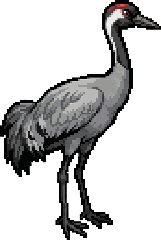
La laguna de Gallocanta, entre las provincias de Zaragoza y Teruel, es una laguna salada y muy poco profunda. Las grullas comunes la usan como dormidero: pasan la noche en el agua y de día se reparten por los campos de cereal de alrededor para comer el grano que queda tras la cosecha. Por eso se juntan aquí por decenas de miles en sus viajes entre el norte de Europa y el sur de la Península.The Gallocanta lagoon, between the provinces of Zaragoza and Teruel, is a very shallow saline lake. Common Cranes use it as a roost: they spend the night in the water and by day spread out over the surrounding cereal fields to eat the grain left after the harvest. That is why they gather here in tens of thousands on their journeys between northern Europe and southern Iberia.
OtoñoAutumn
De mediados de noviembre a diciembreMid-November to DecemberEn cada quincena de ese tramo hubo más de 10.000 grullas en al menos 20 de 21 temporadas. Las primeras llegan en octubre, pero pocas: en la primera quincena la mediana es de 543.In every fortnight of that stretch there were more than 10,000 cranes in at least 20 of 21 seasons. The first ones arrive in October, but only a few: the median for the first half of the month is 543.
El gran picoThe big peak
Del 17 feb al 2 mar17 Feb to 2 MarEl censo más alto de febrero y marzo cayó en esas fechas en las 21 temporadas, y en 16 fue el más alto de todo el año. Suele durar una sola semana.The highest February-March count fell within those dates in all 21 seasons, and in 16 of them it was the highest of the whole year. It usually lasts a single week.
Cuándo mirarWhen to look
Amanecer y atardecerDawn and duskSalen del dormidero al alba y vuelven al final del día. Es cuando se cuentan en los censos oficiales y cuando más se ven en vuelo.They leave the roost at first light and return at the end of the day. That is when the official counts are made and when you see most of them in flight.
Cuántas grullas hay en cada quincenaHow many cranes there are each fortnight
Cada barra es la mediana de 21 temporadas: para cada una se toma el censo más alto de esa quincena y después se busca el valor central. Así una temporada extraordinaria no deforma la imagen de un año normal. Pasa el dedo o el ratón por encima para ver el rango.Each bar is the median of 21 seasons: for each one we take the highest count of that fortnight and then find the middle value, so an exceptional season does not distort the picture of a normal year. Hover or tap a bar to see the range.
Temporada a temporadaSeason by season
El censo más alto del otoño, el más bajo de enero y el más alto del final del invierno en cada temporada. Cada fila enlaza al documento oficial del que sale.The highest autumn count, the lowest January count and the highest late-winter count of each season. Each row links to the official document it comes from.
| TemporadaSeason | Máximo oct-novOct-Nov peak | Mínimo de eneroJanuary low | Máximo feb-marFeb-Mar peak |
|---|---|---|---|
| 2025-2026 | 19.222 18 nov19,222 18 Nov | 4.650 27 ene4,650 27 Jan | 28.227 27 feb28,227 27 Feb |
| 2024-2025 | 34.112 21 nov34,112 21 Nov | 6.798 30 ene6,798 30 Jan | 40.514 20 feb40,514 20 Feb |
| 2023-2024 | 39.560 23 nov39,560 23 Nov | 9.675 18 ene9,675 18 Jan | 28.317 29 feb28,317 29 Feb |
| 2022-2023 | 39.869 17 nov39,869 17 Nov | 6.121 19 ene6,121 19 Jan | 128.743 23 feb128,743 23 Feb |
| 2021-2022 | 19.132 18 nov19,132 18 Nov | 10.908 27 ene10,908 27 Jan | 111.110 17 feb111,110 17 Feb |
| 2020-2021 | 22.179 19 nov22,179 19 Nov | 2.166 14 ene2,166 14 Jan | 42.877 18 feb42,877 18 Feb |
| 2019-2020 | 35.092 14 nov35,092 14 Nov | 3.756 23 ene3,756 23 Jan | 32.351 20 feb32,351 20 Feb |
| 2018-2019 | 44.230 22 nov44,230 22 Nov | 14.498 24 ene14,498 24 Jan | 35.316 21 feb35,316 21 Feb |
| 2017-2018 | 9.345 2 nov9,345 2 Nov | 258 25 ene258 25 Jan | 68.954 22 feb68,954 22 Feb |
| 2016-2017 | 14.192 3 nov14,192 3 Nov | 13.727 26 ene13,727 26 Jan | 20.499 2 mar20,499 2 Mar |
| 2015-2016 | 38.360 5 nov38,360 5 Nov | 11.474 21 ene11,474 21 Jan | 69.487 25 feb69,487 25 Feb |
| 2014-2015 | 22.935 25 nov22,935 25 Nov | 13.450 13 ene13,450 13 Jan | 82.906 24 feb82,906 24 Feb |
| 2013-2014 | 43.216 14 nov43,216 14 Nov | 42.324 23 ene42,324 23 Jan | 65.277 20 feb65,277 20 Feb |
| 2012-2013 | 34.613 31 oct34,613 31 Oct | 5.517 24 ene5,517 24 Jan | 64.703 28 feb64,703 28 Feb |
| 2011-2012 | 29.400 24 nov29,400 24 Nov | 9.908 26 ene9,908 26 Jan | 32.061 1 mar32,061 1 Mar |
| 2010-2011 | 14.818 11 nov14,818 11 Nov | 12.894 27 ene12,894 27 Jan | 114.879 24 feb114,879 24 Feb |
| 2009-2010 | 22.710 19 nov22,710 19 Nov | 5.030 28 ene5,030 28 Jan | 27.350 25 feb27,350 25 Feb |
| 2008-2009 | 24.665 27 nov24,665 27 Nov | 18.283 22 ene18,283 22 Jan | 45.726 26 feb45,726 26 Feb |
| 2007-2008 | 22.287 25 oct22,287 25 Oct | 12.665 24 ene12,665 24 Jan | 48.307 28 feb48,307 28 Feb |
| 2006-2007 | 19.690 9 nov19,690 9 Nov | 6.606 25 ene6,606 25 Jan | 38.120 1 mar38,120 1 Mar |
| 2005-2006 | 27.079 24 nov27,079 24 Nov | 15.774 26 ene15,774 26 Jan | 25.309 2 mar25,309 2 Mar |
Los tres censos más altos de la serie son todos de la segunda quincena de febrero: 128.743 el 23 de febrero de 2023, 114.879 el 24 de febrero de 2011 y 111.110 el 17 de febrero de 2022.The three highest counts in the series all fall in the second half of February: 128,743 on 23 February 2023, 114,879 on 24 February 2011 and 111,110 on 17 February 2022.
Un censo semanal es una foto de un solo día, no el total de grullas que pasan por la laguna en la temporada: muchas se quedan unos días y siguen viaje, y el mismo día pueden haber salido grullas por la mañana antes de contar las que entran por la tarde. Por eso distintas fuentes dan cifras algo distintas para un mismo día.A weekly count is a snapshot of a single day, not the total number of cranes that pass through the lagoon in a season: many stay a few days and move on, and on the same day some may leave in the morning before the evening count of birds coming in. That is why different sources give slightly different figures for the same day.
Lo que dice la cienciaWhat the science says
De unos cientos a decenas de milesFrom a few hundred to tens of thousands
Un estudio publicado en 2020 analizó 45 años de conteos en Gallocanta, de 1973 a 2018. En 1973 el máximo era de unos cientos de grullas; en los últimos años, de muchos miles. También cambió el invierno: las que se quedaban a pasarlo en la laguna eran el 1 % del máximo del otoño anterior en 1973 y el 40 % en 2018A study published in 2020 analysed 45 years of counts at Gallocanta, from 1973 to 2018. In 1973 the peak was a few hundred cranes; in recent years, many thousands. Winter changed too: the birds that stayed on at the lagoon were 1% of the previous autumn's peak in 1973 and 40% in 2018[1].
La comida decide cuántas se quedanFood decides how many stay
Un trabajo de 1994, de investigadores del Museo Nacional de Ciencias Naturales (CSIC) y de la Universidad Complutense, estudió por qué unas grullas se quedan a invernar en Gallocanta y otras siguen hacia el sur. En otoño comen sobre todo grano de cereal y de girasol que queda en los rastrojos. Con el arado y lo que ellas mismas consumen, esa comida va disminuyendo a lo largo del invierno, y el número de grullas en pleno invierno se ajustaba a la cantidad de alimento disponible: cuando no llega para todas, parte de ellas se vaA 1994 study by researchers from the National Museum of Natural Sciences (CSIC) and the Complutense University looked at why some cranes stay to winter at Gallocanta while others move on south. In autumn they feed mainly on cereal and sunflower grain left in the stubble. With ploughing and their own feeding, that food dwindles through the winter, and the number of cranes in midwinter matched the amount of food available: when there is not enough for all of them, some leave[2]. En cambio, cuántas pasan en otoño y en primavera no dependía de la comida. Encaja con lo que muestran los censos: dos picos de paso y un bache en enero que cambia mucho de un año a otro.By contrast, how many pass through in autumn and spring did not depend on food. That fits what the counts show: two passage peaks and a January dip that varies a lot from year to year.
La vuelta al norte se adelantaThe return north is getting earlier
En esos 45 años, el pico de primavera se adelantó 0,37 días por año, unos 3,7 días por década. El estudio lo relaciona con la temperatura: el pico llegaba 11,6 días antes por cada grado de subida de la temperatura media anual, que en Gallocanta aumentó 0,3 °C por década. El nivel del agua y la lluvia de primavera también influían. El paso de otoño, en cambio, no se adelantó de forma significativaOver those 45 years, the spring peak came 0.37 days earlier each year, about 3.7 days per decade. The study links it to temperature: the peak arrived 11.6 days earlier for every degree of rise in mean annual temperature, which at Gallocanta increased by 0.3 °C per decade. Water level and spring rainfall also played a part. The autumn passage, however, did not get significantly earlier[1].
El otoño de 2025 y la gripe aviarAutumn 2025 and avian flu
La temporada 2025-2026 fue anómala. De octubre a diciembre, el censo más alto fue de 19.222 grullas, el 18 de noviembre de 2025; en las otras 20 temporadas la mediana es de 31.953 y solo 2017-2018 se quedó por debajo. A mediados de diciembre se habían recogido 992 grullas muertas desde el comienzo de la migración, según el director provincial de Medio Ambiente, Emilio PérezThe 2025-2026 season was abnormal. From October to December, the highest count was 19,222 cranes, on 18 November 2025; across the other 20 seasons the median is 31,953 and only 2017-2018 was lower. By mid-December, 992 dead cranes had been collected since the start of the migration, according to the provincial environment director, Emilio Pérez[3]. En toda España, el censo nacional de grullas del 18 de diciembre de 2025 contó 47.470 menos que el año anteriorAcross Spain, the national crane census of 18 December 2025 counted 47,470 fewer birds than the year before[4].
Si encuentras una grulla muerta o enferma: no la toques ni recojas plumas o anillas, y avisa a la Reserva en elIf you find a dead or sick crane: do not touch it or pick up feathers or rings, and call the Reserve on 978 64 11 50.
Dónde verlasWhere to see them
La laguna es una Reserva Natural Dirigida desde 2006, con 1.924 hectáreas y otras 4.553 de zona periférica de protección, repartidas entre Santed, Gallocanta, Berrueco y Las Cuerlas (Zaragoza) y Tornos y Bello (Teruel)The lagoon has been a Directed Nature Reserve since 2006, with 1,924 hectares plus a further 4,553 hectares of peripheral protection zone, across Santed, Gallocanta, Berrueco and Las Cuerlas (Zaragoza) and Tornos and Bello (Teruel)[5]. Es también humedal de importancia internacional del Convenio de Ramsar y Zona de Especial Protección para las AvesIt is also a Ramsar wetland of international importance and a Special Protection Area for birds[6].
- Centro de Interpretación de la Reserva, entre Bello y Tornos, con información y atención al visitanteReserve Visitor Centre, between Bello and Tornos, with information and visitor services[7].
- Observatorios: torre-observatorio del Cañizar, observatorio de los Aguanares, de la Ermita, de los Ojos, torre-observatorio de La Reguera y observatorio accesible de GallocantaHides and watchpoints: the Cañizar observation tower, the Aguanares, Ermita and Ojos hides, the La Reguera observation tower and the accessible hide at Gallocanta[6].
- Hides de fotografía, para dos personas y con reserva previa al Gobierno de Aragón. Las reservas para la temporada 2026-2027 se abrieron el 1 de septiembre de 2026Photography hides, for two people, booked in advance with the Government of Aragón. Bookings for the 2026-2027 season opened on 1 September 2026[6].
- Visitas guiadas gratuitas “De ruta con las grullas”, con educadores ambientales, que en las últimas temporadas se han hecho los fines de semana y festivos. Se reservan en la web de laFree guided walks, “De ruta con las grullas”, led by environmental educators, which in recent seasons have run at weekends and on public holidays. Book them on the website of the Red Natural de Aragón.
El Gobierno de Aragón publica en su web los censos semanales de cada temporada, y durante la temporada la Red Natural de Aragón suele dar las cifras en sus noticias. Si vas a finales de febrero, míralos antes de salir: el pico dura una semana y la anterior o la siguiente puede haber muchas menos.The Government of Aragón publishes each season's weekly counts on its website, and during the season the Red Natural de Aragón often gives the figures in its news. If you are going in late February, check them before you set off: the peak lasts a week, and the week before or after there may be far fewer. Censos del Gobierno de AragónGovernment of Aragón counts.
Preguntas frecuentesFrequently asked questions
¿Cuándo es el mejor momento para ver grullas en Gallocanta?When is the best time to see cranes at Gallocanta?
Hay dos momentos. En otoño, de mediados de noviembre a finales de diciembre: en cada quincena de ese tramo se contaron más de 10.000 grullas en al menos 20 de 21 temporadas. Y a finales de febrero, cuando se concentran de vuelta al norte: el censo más alto de febrero y marzo cayó entre el 17 feb y el 2 mar en todas las temporadas revisadas.There are two moments. In autumn, from mid-November to the end of December: in every fortnight of that stretch more than 10,000 cranes were counted in at least 20 of 21 seasons. And in late February, when they gather on their way back north: the highest February-March count fell between 17 Feb and 2 Mar in every season reviewed.
¿A qué hora se ven mejor las grullas en Gallocanta?What time of day is best to see the cranes at Gallocanta?
Al amanecer y al atardecer. Las grullas duermen en la laguna, salen al alba hacia los campos de cultivo de alrededor para comer y vuelven al final del día. Los censos oficiales se hacen precisamente contándolas cuando entran o salen del dormidero.Dawn and dusk. The cranes sleep on the lagoon, leave at first light for the surrounding farmland to feed and come back at the end of the day. The official counts are made precisely by counting them as they enter or leave the roost.
¿Hace falta reservar para ver las grullas?Do I need to book to see the cranes?
Hay que reservar los hides de fotografía, que se piden al Gobierno de Aragón, y las visitas guiadas gratuitas “De ruta con las grullas”, que se reservan en la web de la Red Natural de Aragón. Para la temporada 2026-2027, las reservas de hides se abrieron el 1 de septiembre de 2026.You need to book the photography hides, which are requested from the Government of Aragón, and the free guided walks “De ruta con las grullas”, which are booked on the Red Natural de Aragón website. For the 2026-2027 season, hide bookings opened on 1 September 2026.
¿Qué hago si encuentro una grulla muerta o enferma?What should I do if I find a dead or sick crane?
No la toques ni recojas plumas o anillas. Avisa a la Reserva Natural en el 978 64 11 50. Es la indicación oficial del Gobierno de Aragón, que cobra especial importancia desde el brote de gripe aviar de 2025.Do not touch it or pick up feathers or rings. Call the Nature Reserve on 978 64 11 50. This is the official advice of the Government of Aragón, and it has become especially important since the 2025 avian flu outbreak.
FuentesSources
- Orellana-Macías, J. M., Bautista, L. M., Merchán, D., Causapé, J. & Alonso, J. C. (2020). Shifts in crane migration phenology associated with climate change in southwestern Europe. Avian Conservation and Ecology, 15(1), 16. doi:10.5751/ACE-01565-150116
- Alonso, J. C., Alonso, J. A. & Bautista, L. M. (1994). Carrying capacity of staging areas and facultative migration extension in common cranes. Journal of Applied Ecology, 31, 212-222. doi:10.2307/2404537· versión de acceso abierto (Digital.CSIC)open-access version (Digital.CSIC)
- Diario de Teruel (15/12/2025). Baja la migración de grullas por la gripe aviar mientras los visitantes de la laguna se mantienen.
- Diario de Teruel (14/01/2026). La gripe aviar reduce en 50.000 grullas el número de invernantes en España. Con datos del censo nacional coordinado por José Antonio Román.With data from the national census coordinated by José Antonio Román.
- Ley 11/2006, de 30 de noviembre, de declaración de la Reserva Natural Dirigida de la Laguna de Gallocanta (BOE-A-2007-1614).
- Gobierno de Aragón.Government of Aragón. Reserva Natural Dirigida de la Laguna de Gallocanta.
- Aragón Hoy (16/01/2026). La Reserva Natural Dirigida de la Laguna de Gallocanta retoma sus visitas guiadas.
- Gobierno de Aragón, censos semanales de grulla común (Grus grus) en la cuenca de Gallocanta, temporadas 2005-2006 a 2025-2026. Cada temporada enlaza a su documento en la tabla de arriba.Government of Aragón, weekly Common Crane counts in the Gallocanta basin, seasons 2005-2006 to 2025-2026. Each season links to its document in the table above. Seguimiento de especies.

Antes de ir, míralo en BirdPedyBefore you go, check BirdPedy
En el mapa de BirdPedy puedes ver las observaciones de grulla de los últimos días alrededor de Gallocanta, cada una con su fuente (eBird, iNaturalist, MINKA o la propia comunidad), y en el planificador qué especies se han visto en la zona cada mes. Es gratis, sin anuncios ni compras.On the BirdPedy map you can see the crane sightings of the last few days around Gallocanta, each with its source (eBird, iNaturalist, MINKA or the BirdPedy community), and in the planner which species have been seen in the area each month. It is free, with no ads and no purchases.
Descargar BirdPedy para AndroidGet BirdPedy for Android